Artificial turf performance is often judged at the surface: color, pile height, stitch rate, and the feel underfoot. For commercial buyers, however, the most consequential decision sits one layer deeper. The yarn is the visible wear layer, the part that takes foot traffic, cleats, sunlight, and cleaning. It determines whether a field feels lively or flat, whether a playground stays comfortable through summer, and whether a landscape installation still looks dense after several seasons.
The three main yarn families are polyethylene, polypropylene, and nylon. They are not interchangeable commodities. Each has a distinct balance of softness, resilience, UV stability, cost, and processing behavior. A specification that works for a high-traffic football pitch can be a poor match for a temporary event lawn, and a yarn chosen for a shaded balcony can fail quickly on an exposed roof terrace. The right question is not which polymer is best in general, but which polymer and construction are best for the site, use pattern, and maintenance regime.
This guide explains how PE, PP, and PA yarns behave in commercial projects, where each fits, and how to verify quality before placing an order. It also covers the additives, recycled-content claims, and inspection steps that separate a durable turf system from a short-lived surface.
What PE, PP, and Nylon Yarn Actually Deliver
Polyethylene: the default for comfort and weather exposure
Polyethylene is the dominant artificial turf yarn in sports and landscape work. Industry estimates put PE use above 75 percent of global sports fields, and the reason is practical: it combines soft hand feel, good abrasion performance, and strong UV resistance. A well-made PE yarn can mimic the springy surface of natural grass without the mud, irrigation, and recovery periods. It cushions falls and reduces the harshness that earlier synthetic surfaces were known for, which matters on football pitches, school grounds, and play areas.
For commercial buyers, PE is usually the safest starting point when the site will be exposed to sun, rain, and regular use. UV stabilizers and antioxidants are added to protect the polymer chain from sunlight and heat. The quality and loading of these additives matter more than the label alone. Two PE yarns can look identical in a sample book yet perform very differently after two summers. Reputable suppliers will provide UV stabilization details, yarn tensile data, and outdoor weathering test results rather than relying on color alone.
PE works across a wide temperature range and remains relatively supple in cool conditions. It can be produced in different shapes, such as fibrillated, monofilament, and texturized variants, each with a different hand feel and resilience profile. Fibrillated PE offers good coverage and a traditional grass-like appearance, while monofilament PE can deliver a more upright, premium look. For high-end sports surfaces, engineered monofilament yarns with shaped cross-sections are common because they balance softness with recovery and reduce shine.
Polypropylene: economical, stiff, and best for shorter duty cycles
Polypropylene is lighter and lower in cost than PE. Its density is roughly 80 percent that of PE, so the same yarn count can weigh less. That economic advantage makes PP attractive for temporary lawns, exhibition displays, indoor decor, and short-term event spaces where softness and long outdoor life are less important. PP yarns tend to be stiffer and less forgiving underfoot, and their UV and aging performance is generally weaker than PE. In exposed outdoor settings, a typical PP installation may have a useful life of only two to three years, depending on climate, traffic, and construction.
PP can still be a rational choice when the project brief calls for vivid color, low cost, and a defined service period. Event organizers, staging companies, and indoor display teams often prefer it for exactly those reasons. In the temporary-location market, PP has held a strong share because it delivers acceptable appearance at a low entry cost. Improvements such as PE/PP blends and antistatic additives have reduced some common complaints, including static cling and fiber sticking in dry, cool weather. Even so, PP should not be sold as a long-term substitute for PE in demanding outdoor sports or play applications.
Nylon: tough, resilient, and increasingly specialized
Nylon, or polyamide, was an early mainstay of artificial turf. It offers excellent abrasion resistance and elastic recovery, which means it can spring back after compression. Those properties are valuable in applications where durability under concentrated wear is the overriding requirement. The trade-offs are also significant: nylon is generally harder and rougher to the touch, costs more, and can fade under prolonged sun exposure. For that reason, high-performance PE has replaced nylon in most mainstream sports and landscape uses. Nylon remains relevant in selected specialized areas where exceptional wear resistance justifies the higher cost and firmer hand.
Matching Yarn to the Site, Not the Sample Book
Commercial turf specifications should begin with a use profile. Who uses the site? How many hours per week? Is footwear flat-soled, cleated, or barefoot? Will the surface be shaded, irrigated, exposed to salt air, or installed over a roof? These questions narrow the material choice faster than a visual sample.
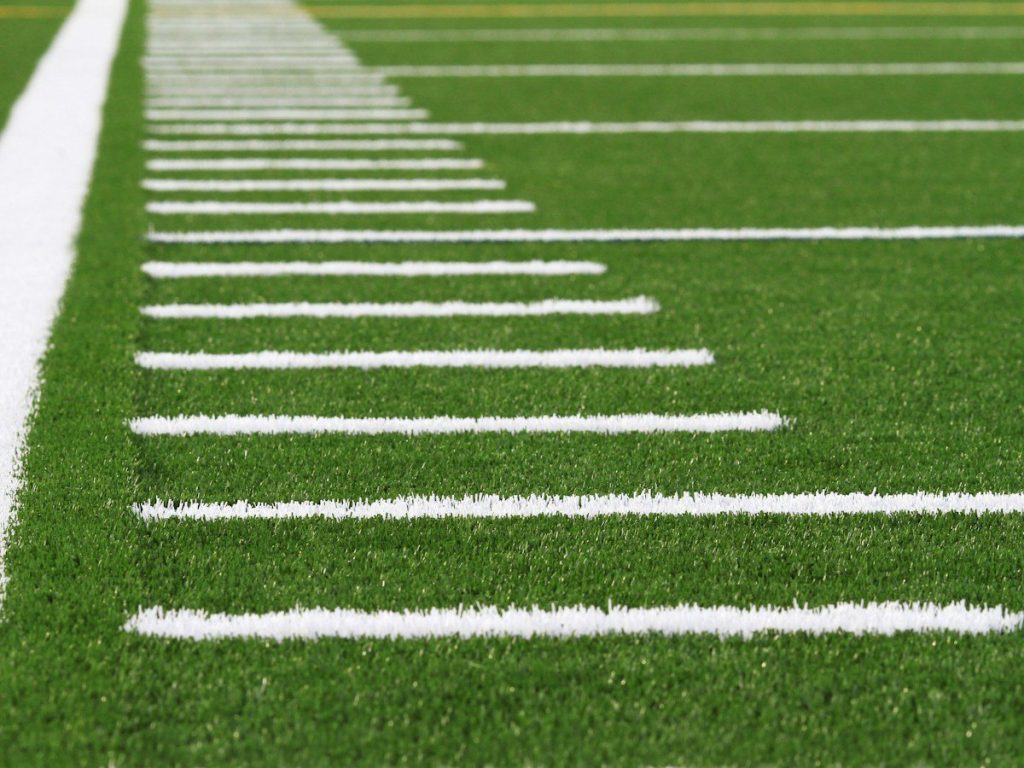
For football, rugby, hockey, and multi-sport surfaces, PE is usually the base polymer. High-performance PE monofilament or engineered shapes provide the combination of softness, resilience, and UV stability needed for frequent play. Cleated sports place high shear stress on the yarn, so tensile strength, pile recovery, and backing integrity must be specified together. A soft PE yarn with a weak backing or low stitch density will not deliver the expected life. For a project with competitive play and long hours, compare football turf systems that are built around the actual level of use, not just the appearance of the sample.
For play and education settings, comfort and safety are central. PE yarn is the common choice, often with a shorter pile and a shockpad beneath. The yarn should be soft enough for bare feet and resilient enough to recover after constant foot traffic. kindergarten turf installations should be specified with attention to fiber softness, heat retention, and drainage. Dark colors absorb heat, so surface temperature and yarn shape matter in sunny climates. A yarn that feels soft in the showroom can still become uncomfortably warm in direct sun; heat reflection and color choices should be considered.
For commercial landscaping and amenity areas, the priority is appearance retention and low maintenance. A durable PE landscape yarn with a natural color blend and good UV package keeps its look through seasonal cycles. commercial landscaping projects often use different yarn heights and densities across lawn areas, pathways, and roof terraces. Roof installations add wind uplift, weight, and drainage considerations, so the yarn must be matched to a suitable backing and fixation system rather than selected in isolation.
For pet areas and family gardens, softness, drainage, and cleanability move up the list. PE yarn with a dense, low-slip construction and an open backing works well when the surface is designed for rinsing and odor control. pet-friendly artificial turf should be paired with an appropriate infill or non-infill system, depending on the owner’s maintenance preferences. In backyard retreats, backyard garden turf can deliver a green, usable lawn under trees or in small courtyards, but shade and leaf litter must be factored into the specification. Fungal growth and staining are rarely solved by yarn alone; drainage and maintenance access are part of the system.
PP is more appropriate for temporary exhibits, indoor displays, and short-duration event lawns where the surface will be removed before UV aging becomes a problem. Nylon may still be considered for specialized, high-wear mechanical areas, but most commercial buyers will find a better balance of cost and comfort in a well-engineered PE yarn.
Comparing PE, PP, and Nylon in Specification Terms
The table below summarizes the practical differences that matter during specification. Use it as a screening tool, then confirm exact performance data with the manufacturer and test reports for the selected batch.
| Material | Hand feel and resilience | UV and aging | Cost position | Best-fit applications | Planning notes |
|---|---|---|---|---|---|
| Polyethylene (PE) | Soft to medium; good recovery in engineered shapes | High when properly stabilized | Medium | Football, rugby, hockey, play, landscape, pet areas, golf greens | Most widely used yarn; above 75 percent of global sports fields; specify UV and antioxidant package |
| Polypropylene (PP) | Firmer; lower resilience | Moderate to low outdoors | Low | Temporary events, exhibitions, indoor decor, short-use displays | Density about 80 percent of PE; exposed life often two to three years; strong in temporary market |
| Nylon (PA) | Hard, rough; excellent elastic recovery | Can fade under prolonged sun | High | Specialized high-abrasion areas | Strong wear resistance but limited by comfort, cost, and color stability |
The comparison shows why PE dominates. It is not the cheapest polymer, but it usually offers the best lifetime value in commercial environments where appearance and safety must hold up over years. PP wins on first cost and vivid color for short-term use. Nylon wins on recovery and abrasion in narrow, intensive applications, but it is difficult to justify for broad commercial use when softer PE options are available.
For a premium putting surface or approach area, golf green turf may use fine PE monofilament and a dense backing. The yarn must be judged as part of the green system, including infill, base, and drainage, because a putting green fails if the surface is soft but the base is not stable. The same system logic applies to sports fields, play areas, and roof terraces.
Additives, Recycled Content, and the Environmental Brief
Modern yarn is not just polymer. Additives shape the life cycle: UV stabilizers protect against photo-degradation; antioxidants reduce heat aging; antistatic agents reduce cling; antimicrobial treatments can support hygiene in pet and play areas but should not replace cleaning. Color pigments affect fade resistance. Buyers should ask for additive package details, not just a claim that the yarn is UV treated.
Environmental claims need scrutiny. Recycled PE and PP content is increasing, but recycled material quality varies. A yarn with recycled content can perform well if the feedstock is controlled and the extrusion process is consistent. It can also fail early if contamination or inconsistent molecular weight undermines tensile strength. Ask for recycled-content percentage, source, traceability, and test data. Avoid accepting a generic sustainability statement as a specification.
Standards such as GB 36246-2018 and equivalent regional sports-surface requirements address safety, harmful substances, and performance. If a project must meet a specific standard, the yarn, backing, infill, and installation should be evaluated as a system. A yarn certificate alone may not cover the finished surface. Also, odor-free and environmentally friendly are marketing terms unless tied to test methods and limits. Request test reports for heavy metals, PAHs, VOC emissions, and skin irritation where relevant.
The direction of travel is clear: higher realism, stronger durability, and better circularity. Recyclable PE and PP yarns, lower-energy production, and improved additive packages are becoming part of commercial specifications. The practical buyer should welcome these advances but treat every environmental claim as a technical question. What is the recycled content? Which standard is met? What is the expected service life? The answers should be documented.
How to Verify Yarn Quality Before It Reaches the Site
The market still includes recycled or off-grade resin sold as virgin polymer. Visual checks are not conclusive, but they can flag risk. Look at yarn gloss and color consistency. Excessive shine can indicate a formulation that may look artificial or wear unevenly. Run a hand-softness test and a recovery test: crush a tuft, release it, and see how it rebounds. Check for loose fibrils, uneven thickness, and excessive powder. Ask for a batch-specific test report covering yarn tensile strength, elongation, UV exposure, and colorfastness. Compare the report date and batch code with the delivered material.
Inspect the full construction, not just the face yarn. Backing weight, coating adhesion, stitch lock, and drainage holes affect how the yarn performs. A strong yarn in a weak backing can pull out under cleats or pet scratching. For indoor or shaded installations, confirm that the selected yarn is appropriate for lower UV exposure but still resistant to humidity and cleaning agents. For coastal sites, consider salt and wind. For roof sites, confirm weight and wind uplift with the system supplier.
A responsible supplier should provide a clear warranty, maintenance guidance, and project references. Warranties should state what is covered: UV degradation, color fade, pile recovery, backing delamination, and seam failure may have different terms. Ask how claims are assessed and what maintenance records are required. If the price is far below comparable PE yarns, examine the additive package, polymer source, and batch consistency. Cheap yarn often hides its cost in shorter replacement cycles.
The material decision should follow the use case. For most commercial sports, play, landscape, and pet applications, a well-specified PE yarn is the most reliable balance of comfort, durability, and UV performance. PP has a legitimate role in temporary and low-cost displays, while nylon is best reserved for specialized high-abrasion needs. The more demanding the site, the less tolerance there is for vague specifications.
A strong specification names the polymer, yarn shape, pile height, stitch rate, backing, additive package, and test standards. It also defines the maintenance plan and the warranty terms. That level of detail protects the owner from premature replacement and protects the contractor from disputes. When buyers compare turf on these terms, the cheapest offer often stops looking cheap.
SUNDOTURF’s commercial turf range is built around matching yarn and system construction to the application, from sports surfaces to landscaped amenity areas. Use the material comparison as a starting point, then verify performance data and test the system as a whole. The right yarn is not simply the softest or the least expensive; it is the one that still performs when the site is busy, the sun is strong, and the maintenance budget is real.