
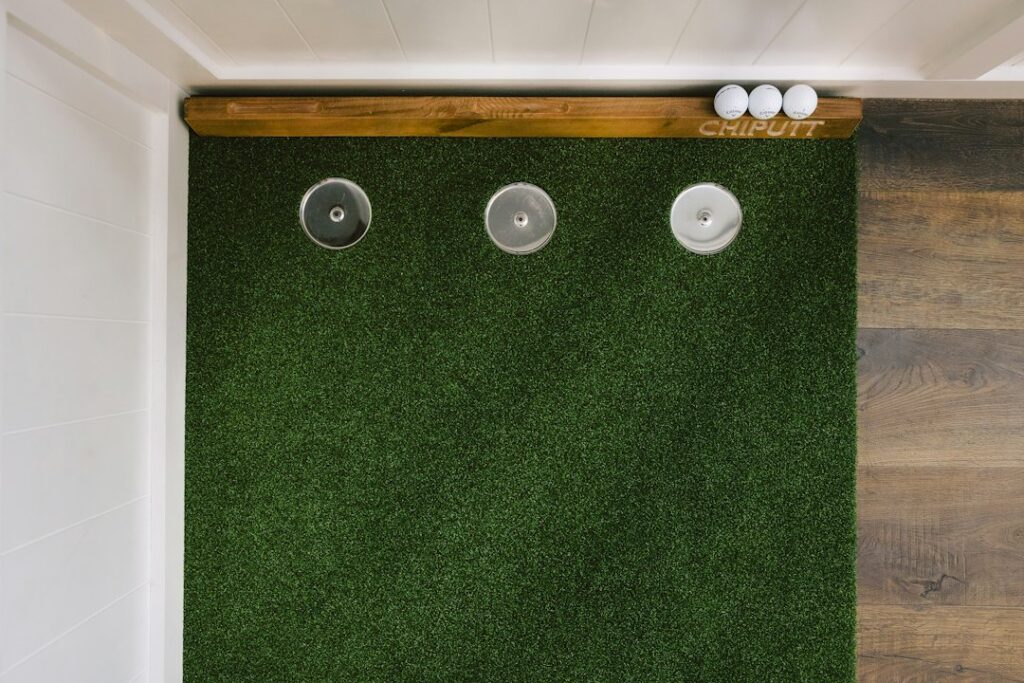
For golf course operators, driving range owners, and landscape contractors, the quality of a putting green directly impacts player experience and maintenance costs. When selecting putting green turf, three technical factors separate professional-grade products from ordinary artificial grass: Stimp speed, density, and fiber. Understanding these elements will help you source the right turf for your project and avoid costly mistakes.
Why Stimp Speed Matters for Putting Greens
Stimp speed, measured with a Stimpmeter, indicates how fast a ball rolls across the green. For natural grass, speeds range from 8 to 12 feet. Artificial putting green turf must replicate these speeds to provide a consistent, realistic experience. The speed is influenced by fiber height, infill type, and the manufacturing process. Professional-grade turf typically offers adjustable speeds from 9 to 11 feet, allowing you to tailor the green to your client’s preference.
When evaluating suppliers, ask for Stimp test data. A reputable manufacturer will provide independent lab results. Without this, you risk installing a surface that plays too slow or too fast, leading to customer dissatisfaction. Remember, speed consistency across the entire green is just as important as the average speed.
Density: The Key to Durability and Performance
Density refers to the number of fibers per square inch. Higher density means more blades per unit area, which translates to better ball roll, improved durability, and a more realistic appearance. For putting greens, density should be at least 50,000 fibers per square meter, with premium products exceeding 70,000. Low-density turf compacts quickly, causing inconsistent ball roll and premature wear.
Density also affects the green’s ability to hold a golf ball. A dense surface supports the ball slightly, reducing bounce and mimicking natural grass. When sourcing, check the density specification and consider the infill material. Silica sand infill is common for putting greens because it adds stability and allows for speed adjustment.
Fiber: The Building Block of Quality Turf
The fiber type, shape, and material determine how the turf performs over time. Most professional putting greens use polyethylene (PE) or a PE/nylon blend. PE offers softness and natural feel, while nylon adds resilience and memory. The fiber shape—such as texturized or monofilament—affects how the ball rolls and how the turf recovers after foot traffic.
Look for fibers with UV stabilization to prevent fading and degradation from sunlight. A high-quality fiber will have a consistent denier (thickness) and a blade-like shape that mimics natural grass. Some manufacturers use a dual-fiber system: a primary fiber for performance and a secondary fiber for support. This innovation enhances both Stimp speed and durability.
Other Factors That Influence Putting Green Performance
While Stimp speed, density, and fiber are critical, other elements also play a role. The backing system provides dimensional stability and drainage. A permeable backing prevents water pooling, which can ruin the green. The installation method—whether glued down or infilled—also affects playability. For a seamless look, consider a turf with a thatch layer that mimics the thatch of natural grass.
Additionally, the manufacturer’s quality control processes ensure consistent fiber distribution and pile height. As a B2B buyer, you should request samples and test them for ball roll, recovery, and feel. If you’re also sourcing other artificial grass products, such as landscape artificial grass or football artificial turf, working with a single supplier can streamline logistics and ensure uniform quality.
How to Select the Right Putting Green Turf for Your Market
Different markets have different expectations. In the US, golfers prefer faster greens, while in Europe, slightly slower speeds are acceptable. Climate also matters: in hot, sunny regions, UV-resistant fibers are essential. For indoor applications, lower density may suffice, but outdoor installations require higher density and durable fibers.
When evaluating suppliers, consider their experience and certifications. A factory-direct producer like Sundoturf can offer customized specifications to meet your specific needs. We provide detailed technical data, including Stimp speed, density, and fiber composition, so you can make an informed decision. Our putting green turf is engineered for professional performance and long-lasting durability.
Conclusion
Stimp speed, density, and fiber are the three pillars of professional putting green turf. By understanding these factors, you can source turf that delivers consistent performance, satisfies your clients, and withstands heavy use. Whether you’re a contractor, importer, or golf facility owner, investing in quality turf pays off in the long run.
At Sundoturf, we specialize in manufacturing high-quality artificial grass for putting greens and other applications. Our team can help you select the right product for your project. Contact our team today to discuss your requirements, or browse our full product range to see our latest offerings. Let us help you create exceptional putting greens that stand out.