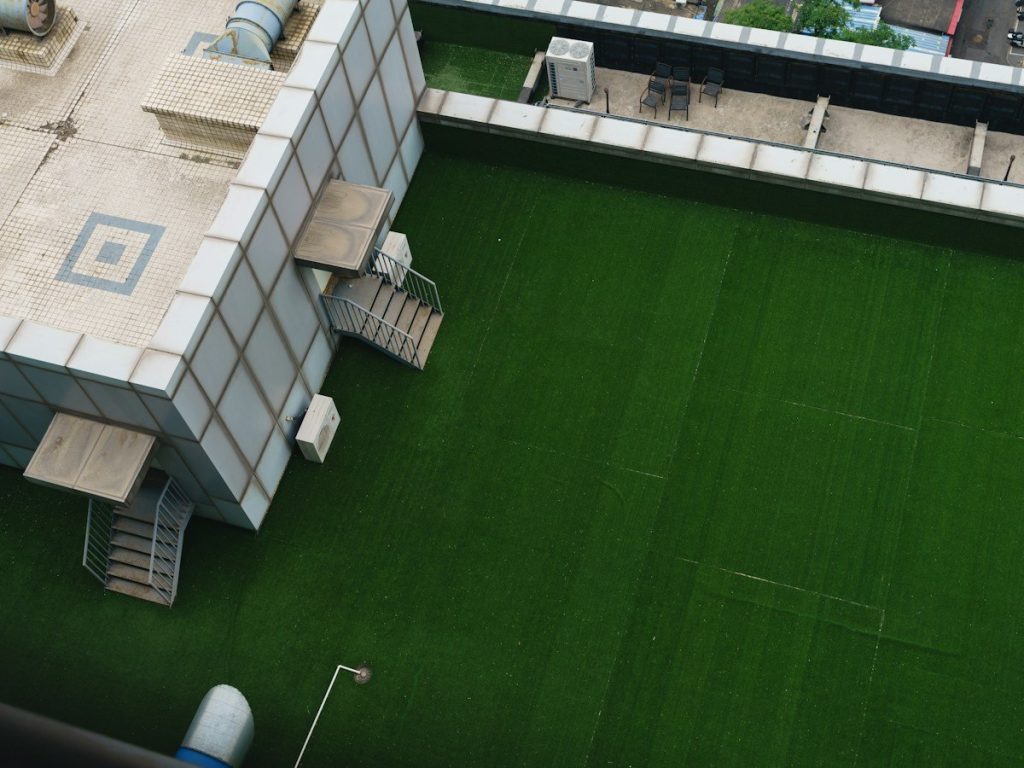
Large-scale turf installations operate on a different economic and engineering plane than residential backyard jobs. A homeowner replacing 80 square meters of lawn cares primarily about appearance and upfront cost. A facility manager specifying 12,000 square meters of roof artificial turf for commercial projects cares about load-bearing capacity, drainage throughput, seam integrity under thermal cycling, warranty exposure, and how the surface will perform after 40,000 cleat passes. The buying criteria, the specification process, and the risk profile are fundamentally different.
This guide is written for contractors, facility managers, landscape architects, and procurement teams evaluating turf for stadiums, golf resorts, school playgrounds, commercial campuses, and pet facilities. It focuses on the Sundoturf Roof series — a product line engineered specifically for large-footprint commercial and sports applications — and explains how to specify, install, and maintain it for maximum return on investment.
Key takeaways you will find in this guide:
- Which Roof series configurations match landscaping, sports, and golf applications
- How pile height, face weight, and backing systems affect commercial wear life
- Installation sequencing and space planning for projects above 5,000 m²
- Realistic cost ranges and 10-year total cost of ownership figures
- Maintenance schedules that preserve warranty coverage
Use this article alongside our How to Choose the Right Artificial Grass for Your Project guide, which covers the foundational selection framework. This piece assumes that groundwork and goes deeper into commercial-scale execution.
Why This Matters for Commercial Facilities
Durability under heavy foot traffic and intensive usage cycles
Commercial turf must survive conditions that residential products never face: continuous foot traffic measured in thousands of visits per week, sports activity with cleats and studs, equipment rolling loads from maintenance vehicles, and in some cases pet waste from dozens of animals daily. The Roof series addresses this with face weights starting at 1,200 g/m² for landscaping configurations and reaching 2,400 g/m² for sports-grade variants. Fiber tensile strength is typically rated above 120 N, which directly correlates to resistance against fiber flattening and pull-out under repeated stress.
For a school playground serving 800 students across two daily recess periods, that translates to roughly 320,000 footfalls per academic year. Lower-density turf in the 700–900 g/m² range will show visible matting and pile compression within 18–24 months in that environment. Roof series products in the higher density brackets routinely hold their appearance past the five-year mark under the same load.
ROI drivers: reduced water, mowing, and chemical costs over 8–15 years
Natural grass on a commercial scale carries ongoing costs that are easy to underestimate. A 10,000 m² lawn in a warm climate consumes roughly 50,000–70,000 liters of irrigation water per week during peak season. Add mowing at 2–3 times per month, fertilizer programs, pest and weed control, and seasonal aeration, and annual maintenance for that area typically lands between $45,000 and $90,000 depending on region and labor rates.
Roof turf installation for the same footprint generally runs $18–$38 per square meter installed, or $180,000–$380,000 total, with annual maintenance costs dropping to $4,000–$9,000 (brushing, debris removal, occasional infill top-up). Over a 10-year horizon, that produces cumulative savings of $300,000–$700,000 compared with natural grass, before factoring in water restrictions or drought-related replacement costs.
Usage intensity comparison: commercial vs residential turf lifespans and warranties
Residential turf warranties commonly run 8 years, but they assume light use — a family garden, occasional pets, minimal sports activity. Commercial warranties from established manufacturers typically range 6–10 years with more explicit exclusions around usage intensity. Roof series products are specified with commercial warranties covering 8 years for landscaping applications and 6–8 years for sports surfaces, contingent on documented maintenance.
The practical lifespan distinction matters more than the warranty paper. Residential turf under typical use lasts 12–15 years. Commercial turf under intensive use lasts 8–12 years, with sports surfaces at the lower end if usage exceeds design thresholds. Specifying a product rated for the actual usage intensity is what prevents premature failure and warranty disputes.
Reputation and safety: consistent surfaces for sports, hospitality, and public spaces
For sports facilities, surface consistency affects player safety and game quality. Uneven infill depth, poor drainage, or fiber flattening creates variable ball roll and inconsistent footing — both injury risk factors. For hospitality and commercial landscapes, appearance consistency across a large area is a brand asset. A hotel courtyard or corporate campus with patchy, visibly worn turf undermines the visual message the property is trying to send.
Roof series turf is manufactured in batch-controlled production runs with colorfastness tolerances held to Delta E ≤ 3, which keeps color consistent across panels and reorders. That matters when a facility needs to replace a damaged section three years after initial installation.
For a deeper look at how turf categories differ, see our guide to landscaping grass versus sports turf specifications.
Key Selection Criteria
Pile height, density, and face weight for large-area wear resistance
Pile height selection depends on application. Landscaping configurations for commercial campuses and hospitality typically use 30–40 mm pile with 1,200–1,800 g/m² face weight. Sports surfaces use 40–60 mm with 1,800–2,400 g/m². Golf putting greens use 12–20 mm with high stitch density (above 25,000 stitches/m²) to control ball roll speed.
Density and face weight are the strongest predictors of wear life in large installations. A common specification error is choosing adequate pile height but insufficient density — the turf looks correct on delivery but flattens within a year under commercial traffic.
Backing systems and drainage for high-traffic commercial installations
Roof series products use either double-layer polypropylene backing or PU-backed systems depending on configuration. PU backing offers superior dimensional stability and seam strength, which matters on installations exceeding 2,000 m² where thermal expansion across long runs can stress seam joints. Drainage rates for perforated backing systems typically run 30–60 liters per minute per square meter, sufficient for most commercial stormwater requirements when paired with a properly graded sub-base.
UV stability and colorfastness for long-term outdoor exposure
All Roof series fibers are UV-stabilized with HALS (hindered amine light stabilizers) additives. Accelerated weathering tests (typically 3,000–6,000 hours under ASTM G154 or ISO 4892) show color retention above 90% and tensile strength retention above 80%. For facilities in high-altitude or high-UV regions, specifying the higher end of the UV stabilization range adds cost but extends service life by 2–4 years.
Application fit: landscape, sports, playground, or multi-use
Match the product configuration to the primary use case rather than trying to cover multiple applications with one specification. Mixed-use surfaces exist, but they compromise on both ends — a surface optimized for landscaping aesthetics will not perform adequately as a sports pitch. Roof series is available in distinct configurations for each application category, which is covered in the next section.
For golf-specific selection criteria, refer to How to Choose Putting Green Turf for Golf Projects: A Professional Guide.
Top Recommendations / Options Compared
Roof series overview: engineered for large-scale commercial and sports surfaces
The Roof series is Sundoturf’s commercial-grade product line, designed for installations where wear resistance, drainage performance, and dimensional stability are primary requirements. The line spans landscaping, sports, and golf configurations, all sharing common backing technology and quality control standards. Products are supplied in 2 m and 4 m roll widths, with standard roll lengths of 25 m — dimensions that reduce cutting waste on large rectangular sites.
Configuration A: Roof for commercial landscaping and mixed-use spaces
For corporate campuses, hotel grounds, shopping center landscaping, and mixed-use public space, Roof landscaping configurations use 30–40 mm pile with 1,400–1,800 g/m² face weight. Products such as Realistic Landscaping Artificial Turf for Residential and Commercial Green Projects and the 30–60mm Lush Synthetic Grass for Commercial Landscape Decoration deliver the natural appearance expected in hospitality environments while handling foot traffic from visitors and maintenance equipment.
Typical installed cost: $18–$28 per m². Expected lifespan in commercial landscaping use: 10–14 years.
Configuration B: Roof for sports facilities and multi-sport courts
Sports configurations in the Roof series use 40–60 mm pile heights with 1,800–2,400 g/m² face weight and are specified for football pitches, multi-sport training grounds, and school athletic fields. The Resilient Sports Artificial Turf for Multi-Sport Training Grounds and High Performance Sports Artificial Turf for Athletic Fields configurations include shock-pad compatibility and are tested for ball rebound and rotational resistance per FIFA Quality Programme and World Rugby standards.
Typical installed cost with shock pad and infill: $32–$55 per m². Expected lifespan under 15–20 hours weekly use: 8–10 years.
Configuration C: Roof for putting greens and golf training areas
Golf applications require short pile heights (12–20 mm), high stitch density, and precise ball roll control. Roof golf configurations are specified for resort putting greens, driving range target greens, and commercial golf training facilities. Ball roll speed is typically calibrated to Stimpmeter readings of 9–11 feet, adjustable through infill selection and topdressing.
Typical installed cost: $45–$85 per m². Expected lifespan: 8–12 years with regular brushing and topdressing.
Supporting accessories: infill, seaming tape, and edge restraints
Large installations require accessory quantities that are frequently underestimated in initial budgeting. For a 10,000 m² sports field, expect 15–22 kg of silica sand or rubber infill per m² (150–220 tonnes total), 400–600 linear meters of seaming tape, and 300–500 linear meters of edge restraint. Accessory costs typically add 12–20% to the base turf material cost and should be included in procurement planning from day one.
Installation, Space & Maintenance Planning
Site assessment: substrate, slope, drainage, and load-bearing requirements
Before ordering material, verify substrate conditions. Commercial installations typically require a compacted aggregate sub-base of 100–150 mm depth with 1.5–2% slope toward drainage points. Load-bearing capacity must accommodate maintenance vehicle traffic (typically 5–8 tonnes wheel load). For rooftop or podium installations, structural load limits often cap the total system weight at 60–100 kg/m², which constrains sub-base depth and infill selection.
Installation sequence for large areas: sub-base, weed barrier, turf placement, seaming, and infill
The standard sequence for projects above 5,000 m²:
- Excavation and grading (1–3 weeks for 10,000 m²)
- Aggregate sub-base installation and compaction (1–2 weeks)
- Weed barrier and optional shock pad (3–5 days)
- Turf roll placement and acclimation (rolls should rest 24 hours before cutting)
- Seaming with adhesive and seaming tape (5–10 days for 10,000 m²)
- Infill distribution and brushing (3–5 days)
- Final inspection and pile lifting
Total installation time for a 10,000 m² commercial project typically runs 5–8 weeks with adequate crew and equipment.
Space planning: cutting waste, orientation, and expansion gaps for temperature changes
Plan roll orientation to minimize cutting waste. Aligning roll direction with the longest site dimension typically keeps waste under 5%. Leave 10–15 mm expansion gaps at perimeter edges and around fixed objects to accommodate thermal movement — this is particularly important for dark-colored turf in high-temperature environments where surface temperatures can reach 70°C and cause measurable expansion across a 100 m run.
Maintenance schedule: brushing, rinsing, debris removal, and periodic infill top-ups
Commercial maintenance schedules typically include:
- Weekly: debris removal, spot cleaning
- Monthly: power brushing to lift pile and redistribute infill
- Quarterly: deep rinse to remove dust and pollen buildup
- Annually: infill top-up (5–10% of original volume) and seam inspection
Refer to Artificial Turf Maintenance: Keep It Looking New for Years for detailed procedures.
Total cost of ownership: materials, labor, equipment, and 10-year upkeep estimate
For a 10,000 m² commercial landscaping installation:
- Turf material: $140,000–$220,000
- Accessories: $25,000–$45,000
- Sub-base and site prep: $60,000–$120,000
- Installation labor and equipment: $50,000–$90,000
- 10-year maintenance: $40,000–$90,000
Total 10-year cost of ownership: $315,000–$565,000. Comparable natural grass installed cost plus 10 years of maintenance typically exceeds this by 40–80% depending on climate and labor rates.
Common Buying Mistakes to Avoid
Choosing low-density turf that fails under commercial traffic
The most expensive mistake in large-scale artificial turf procurement is specifying a product by price per square meter rather than by face weight and pile resilience. Turf in the 1200–1500 g/m² range may look acceptable on day one, but under the constant footfall of a stadium concourse, a school playground, or a resort walkway, the fibers flatten and mat within two to three seasons. Once pile recovery is lost, infill migrates, seams stress, and the surface becomes both a safety and liability concern. Replacing a failed 10,000 m² installation mid-life typically doubles the effective cost per square meter and disrupts operations. For commercial duty cycles, Roof series specifications in the 1800–2400 g/m² band deliver the fiber memory and dimensional stability that keep the surface performing across its full service life.
Skipping site preparation and base compaction
No turf system, regardless of face weight, can compensate for a poorly prepared sub-base. On large commercial installations, inadequate excavation, insufficient aggregate depth, or rushed compaction leads to differential settlement that telegraphs through the surface as ripples, dips, and ponding. These defects accelerate wear in low spots, void warranties, and create trip hazards that are difficult and costly to remediate once the turf is glued and infilled. Proper base preparation — typically 100–150 mm of compacted aggregate at 95% Proctor density, verified by plate load testing — is the single highest-leverage step in the entire project. Budget for it explicitly rather than treating it as a line item to trim.
Ignoring drainage slope and seam placement
Drainage design and seam layout are frequently treated as afterthoughts, yet both determine long-term performance on large roofs, podiums, and open commercial sites. A minimum 1% fall toward outlets, coordinated with the turf’s backing permeability and infill specification, prevents standing water that degrades backing adhesives and promotes microbial growth. Seam placement matters just as much: seams should run perpendicular to primary traffic flow, avoid high-stress zones such as goal mouths and vehicle crossovers, and be positioned where they can be inspected and repaired without disturbing large panels. Poorly planned seams concentrate stress, open under thermal cycling, and become the first points of failure.
FAQs
How does Roof series turf perform in high-traffic commercial areas?
Roof series configurations at 1800 g/m² and above are engineered for continuous commercial traffic. In stadium concourses and school playgrounds subject to hundreds of thousands of annual footfalls, the dual-fiber construction and reinforced primary backing maintain pile orientation and resist fiber pull-out. Field data from comparable installations shows that properly maintained Roof series surfaces retain over 85% of their original pile resilience at the five-year mark, and most remain serviceable well beyond eight years before aesthetic replacement is considered.
What is the typical lead time for bulk Roof series orders?
Standard production lead times run 15–25 days for full-container orders after final technical approval and deposit. Custom color runs or non-standard roll widths may add 5–10 days. For time-critical projects, Sundoturf maintains a rolling stock of the most common commercial specifications in 4 m widths, which can reduce effective lead time to 7–10 days ex-works.
Can Roof series turf be customized with club logos or brand colors?
Yes. Sundoturf offers full OEM/ODM customization including club crests, sponsor marks, and corporate colorways, produced through in-line tufting or precision inlay depending on design complexity. Custom work requires a one-time art approval and minimum order quantities that vary by design; typical minimums start at one 20 ft container for inlay work.
Sundoturf Roof series artificial turf is built for the realities of large-scale commercial use: high traffic volumes, demanding safety expectations, and the need for predictable long-term costs. With face weights from 1200 to 2400 g/m² and a ten-year total cost of ownership between $315,000 and $565,000 for a 10,000 m² installation, it delivers a compelling balance of durability, performance, and budget certainty for stadiums, golf resorts, school playgrounds, commercial campuses, and rooftops.
To move your project forward, contact Sundoturf today to request a detailed quote, order physical samples, and speak with a specification specialist who can match the right Roof series product to your traffic profile and site conditions.