
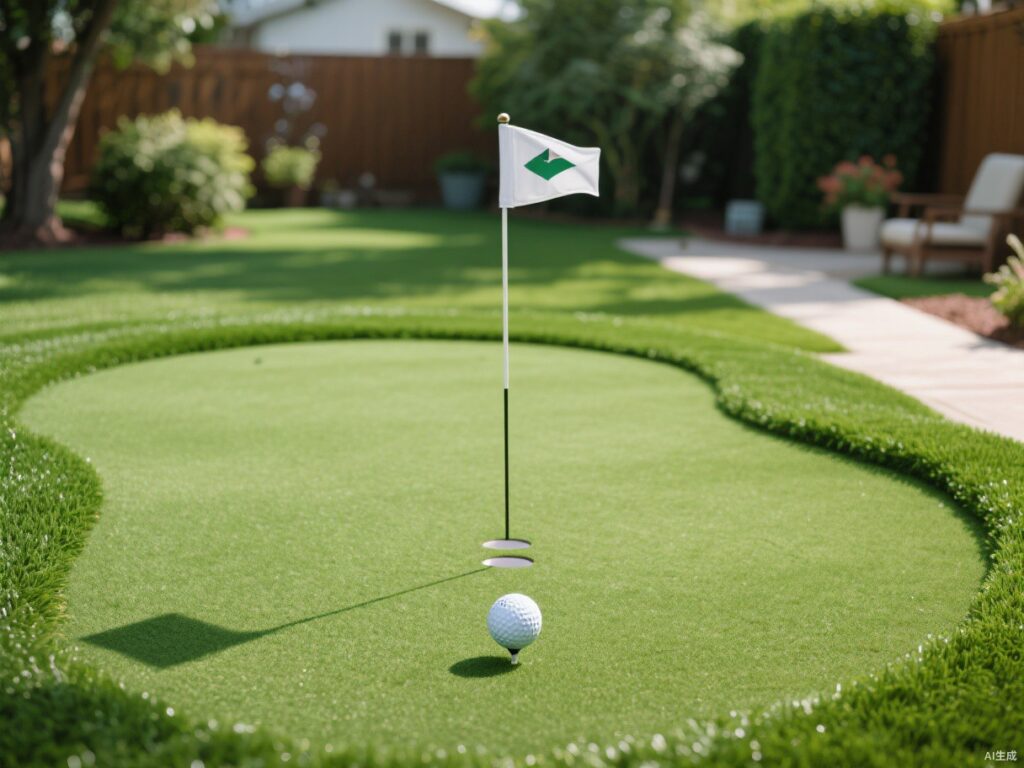
A great putting surface can make or break a golf facility, practice area or backyard green. Modern putting green turf has evolved to replicate the speed and true roll of natural bentgrass — without the daily mowing, watering and specialist maintenance. But not all golf turf is created equal.
This guide explains the specifications that matter when choosing putting green turf for commercial golf projects, driving ranges, hotels and residential installations.
What Makes Putting Green Turf Different?
Unlike landscape or sports turf, putting green turf is engineered for one thing: a smooth, consistent ball roll. That requires a short, dense pile with tightly packed fibers and a firm, stable backing. The goal is a surface that accepts chip shots, holds a line and rolls true at a predictable speed.
Pile Height and Density
Putting surfaces typically use a very short pile — usually between 10mm and 16mm — with extremely high stitch density. The shorter and denser the pile, the faster and truer the ball roll. Fringe and approach areas use a taller pile (30–40mm) to simulate the first cut of rough.
When comparing products, ask for the stitch rate and total face weight, not just pile height. Higher density delivers better durability and a more consistent playing surface over years of use.
Ball Roll Speed (Stimp Rating)
Serious buyers evaluate putting turf by its ball roll speed, measured on the stimpmeter scale. Recreational backyard greens typically run 8–9 on the stimp, while club and commercial installations often target 10–11 for a faster, tournament-style surface. Quality manufacturers can tune fiber type and infill to hit a target speed.
Fiber Material and UV Stability
Most putting green turf uses either nylon (polyamide) or polypropylene fibers. Nylon is more resilient and holds its shape under foot traffic and pitch marks, making it the premium choice for high-use facilities. Whichever fiber you choose, ensure it carries UV stabilization rated for your climate — especially for outdoor greens in high-sun regions.
Backing and Drainage
A stable, permeable backing is critical. The turf must drain quickly after rain and resist dimensional movement under temperature swings. Look for a reinforced backing with good tuft-bind strength, and plan the base preparation (compacted aggregate with proper grading) to match.
Infill and Performance Tuning
Many putting systems use a fine silica sand infill to control ball speed, add ballast and keep fibers upright. The amount and grading of infill directly affect firmness and roll. Your manufacturer should advise on the recommended infill specification for your target stimp speed.
Applications Beyond the Golf Course
Putting green turf is increasingly specified for hotel amenities, corporate campuses, rooftop terraces, cruise ships and residential backyards. Custom shapes, multiple hole locations, fringe collars and integrated tee boxes can all be fabricated to order.
OEM and Project Customization
For distributors, contractors and golf brands, factory-direct sourcing opens up OEM options: custom pile specifications, branded backing, private-label packaging and project-specific dimensions. Sampling before bulk orders ensures the speed and feel match your requirements.
Conclusion
Choosing putting green turf comes down to pile height, density, fiber resilience, drainage and target ball speed. Specify these clearly and work with a manufacturer that can certify performance and customize to your project. Get in touch for samples, stimp-speed data and a tailored quotation for your next golf installation.