When commercial buyers compare artificial grass, color and pile height often dominate the first conversation. Flexibility deserves equal attention. It shapes how the surface feels underfoot, how safely it absorbs impact, how naturally it recovers after traffic, and how long it survives repeated installs, cleanings, and weather cycles. A turf that looks dense in a sample but feels brittle under foot is a liability in playgrounds, sports fields, pet areas, and high-end landscapes.
Flexibility is not a single material property. It is the result of fiber polymer, yarn construction, backing architecture, and adhesive chemistry working together. PE fibers can feel soft and springy; PP fibers can add body and dimensional stability; PA fibers can deliver strength. Backing and coating can either preserve that suppleness or lock the product into a stiff sheet that wrinkles, cracks, and ages prematurely. For professional specifiers, flexibility is a system-level decision, not a line item on a datasheet.
This article explains what flexibility means in commercial artificial turf, how to evaluate it before purchase, and how to match it to applications from playground turf to football turf systems. The goal is practical: specify a surface that feels right, performs under load, and still makes commercial sense over its service life.
Why Flexibility Is a Commercial Performance Specification
Flexibility affects more than hand feel. On a commercial site, it influences impact attenuation, foot stability, seam performance, and the risk of premature failure. A soft, resilient turf can cushion falls, reduce skin abrasion, and recover quickly from foot traffic. A stiff turf may pass a visual inspection at delivery yet develop memory creases, edge lifting, or cracking when installed over dynamic subbases or exposed to temperature swings.
For sports surfaces, flexibility interacts with shockpad, infill, and fiber resilience. The fiber must flex without collapsing, allowing cleats or shoes to release cleanly while the surface returns to level. For landscape and leisure areas, flexibility controls how the grass feels to bare feet, children, and pets. In mixed-use spaces, it helps the same product move from visual amenity to functional floor. Buyers who ignore it often pay later through callbacks, repairs, and reduced usable hours.
Flexibility also has a commercial relationship with installation. A turf that bends easily conforms to slight contours, wraps around edges, and handles seaming without stress. Stiff rolls can require more force, stronger adhesives, and longer acclimation. On roofs, balconies, and irregular landscapes, that difference can determine whether a clean detail is possible. This is why flexibility should be discussed alongside weight, drainage, and backing type rather than as a vague comfort claim.
The right level of flexibility is application-specific. A putting green needs a crisp, consistent surface, while a kindergarten needs forgiving softness. A football pitch needs a balance: enough give to protect players, enough resilience to resist divots and fiber flattening. A pet area needs softness plus dimensional stability for cleaning. Treating flexibility as one universal more-is-better target can lead to underperformance in demanding sports or over-soft products in high-traffic public zones.
Fiber Selection: PE, PP, PA and Yarn Construction
Fiber choice is the first lever for flexibility. In commercial artificial grass, PE is usually the benchmark for softness and rebound. Quality PE yarn can mimic the supple feel of natural grass, recover after compression, and resist the scratchy, brittle hand feel that signals poor material selection. PP is stiffer and more dimensional, useful where body and durability matter more than tactile softness. PA offers high tenacity and toughness, but it is not automatically the softest option; it is often reserved for technical sports where strength and resilience dominate.
Construction details decide how much of the polymer advantage reaches the finished product. Finer yarns can increase softness, but they must still carry enough mass and resilience for the traffic level. A balanced twist helps filaments work together without matting or opening. Cross-section design also matters: shaped or curved sections can improve recovery, reduce glare, and create a more natural hand feel. A low-cost fiber with aggressive twist may look dense in a sample but become wiry, flattened, or brittle after installation.
| Fiber or system | Flexibility profile | Strengths | Watchouts | Typical commercial fit |
|---|---|---|---|---|
| PE | High | Soft hand, fast rebound, natural appearance | Requires quality stabilization for heavy wear | Kindergartens, landscapes, leisure, multi-use comfort zones |
| PP | Medium | Dimensional stability, wear resistance, cost control | Firmer hand; less tactile comfort | Utility sports areas, mixed-fiber systems, low-comfort-demand zones |
| PA | Moderate flexibility with high toughness | Strength, abrasion resistance, resilience | Can feel firm and cost more | Technical sports and special-purpose fields |
| PE and PP blend | Tuned medium to high | Balances softness, body, and recovery | Requires disciplined blend and process control | Football, multi-sports, high-use training surfaces |
For commercial specifications, avoid the shorthand that PE is always soft and PP is always cheap. The meaningful question is how the yarn is engineered: polymer grade, dtex, filament count, twist, heat setting, and cross-section. A well-built PE can handle serious traffic; a poorly stabilized PP can still fail early. Request sample cards, bend them, press them, and compare recovery after repeated compression. Combine fiber review with sports artificial turf performance criteria so softness does not come at the expense of play.
Backing and Adhesive Systems That Preserve Flexibility
Fiber sets the hand feel, but backing and coating decide whether the finished turf behaves like a flexible textile or a rigid sheet. The backing must hold tufts securely without eliminating the product’s ability to drape, flex, and recover. A composite of PP cloth and nonwoven fabric is often a strong choice for commercial turf because it combines dimensional stability with bending comfort. Pure PP backing can be serviceable but tends to feel firmer. Mesh backing may offer high strength for intense sports use, yet its openness and stiffness can reduce overall suppleness and require careful installation.
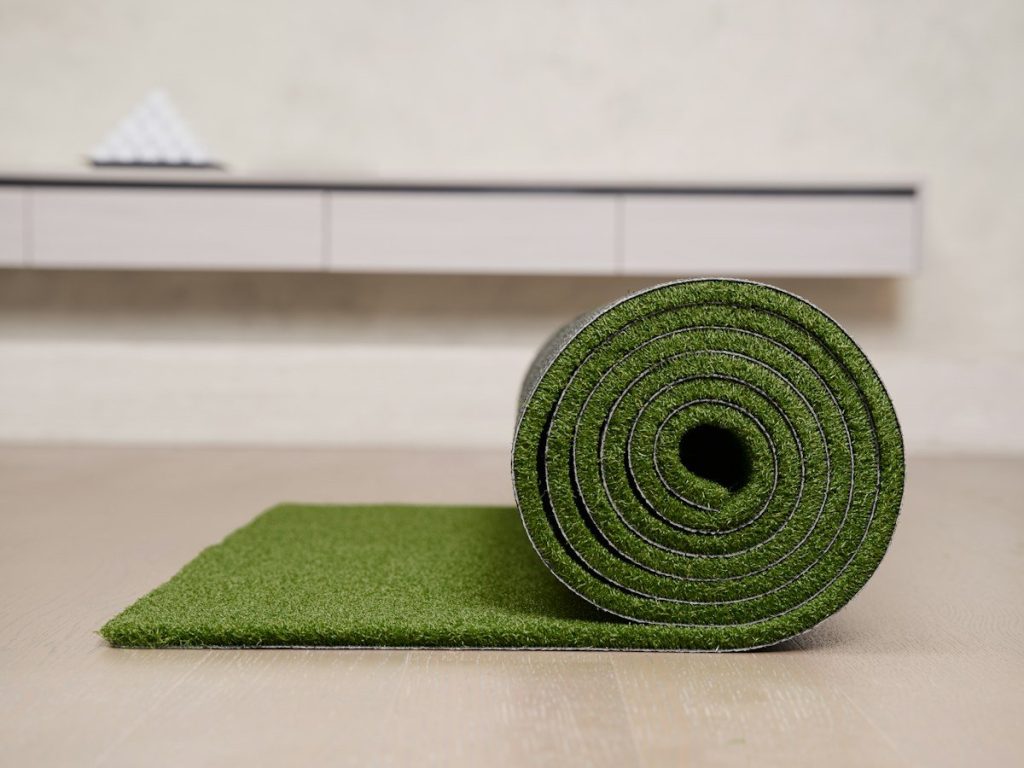
Adhesive chemistry is equally important. Flexible PU coatings are designed to lock fibers in place while allowing the turf to move with the subbase and temperature changes. Hard, brittle coatings may lower production cost, but they can make the roll stiff, increase curl at edges, and create crack paths when the turf is rolled, folded, or installed over uneven ground. On a commercial project, those small material decisions become maintenance costs: lifted seams, curling edges, wrinkle memory, and callbacks after the first hot season. Ask for backing samples and bend them repeatedly. A good system should flex without whitening, cracking, or shedding fiber.
Backing also affects drainage and installation speed. A flexible, well-bonded system can conform to contours and work with appropriate drainage layers without blocking water movement. The exact specification should match the subbase, infill, and fixing method. For roof terraces or podium landscapes, lightweight flexibility is especially valuable, but it must be paired with wind uplift and drainage planning. For commercial artificial turf projects, request backing weight, coating type, delamination performance, and roll memory data rather than accepting a generic soft claim.
Field Checks and Standards-Based Testing
Buyers do not need a laboratory to screen out obvious flexibility failures. At sample review, use three simple actions. First, press the turf firmly with your palm or thumb and watch recovery: quality turf returns quickly without leaving a hard dent. Second, pull a small cluster of fibers gently sideways and release; the fibers should resist deformation and settle back rather than stay splayed. Third, bend the backing and roll the sample over a short edge; a sound product should flex without a sharp crease, cracking, or visible separation between fiber and backing.
These field checks are screening tools, not a substitute for test data. A professional specification should ask for elongation at break, tensile strength, tear resistance, bending performance, and backing adhesion. Where the project requires a recognized standard, request results aligned with the relevant method, such as GB/T 20197-2006 for certain artificial turf properties. Compare results against the application: a playground and a hockey pitch should not share the same target. Values should be supported by batch-consistent production data, not a single golden sample.
What to Request From a Supplier
Ask for fiber composition, dtex or yarn size, twist level, backing construction, coating chemistry, roll weight, and a flexibility statement tied to the intended use. Request a production sample, not only a display card. Test how the sample behaves after repeated folding, compression, and exposure to warm conditions. If the supplier cannot explain why a product is flexible, the specification is probably relying on soft hand feel rather than controlled engineering.
Also review installation tolerance. A flexible turf may still fail if it is installed on a poor subbase, seamed with incompatible adhesive, or exposed to sharp edges. Include acceptance criteria for wrinkles, edge curl, seam strength, and surface flatness. This turns flexibility from a subjective sales word into a measurable part of quality control.
Matching Flexibility to Applications and Avoiding Failure
Different commercial applications need different flexibility profiles. In early-years settings, the priority is comfort and safety: soft PE fibers, a forgiving composite backing, and a surface that reduces abrasion during falls and play. A kindergarten turf specification should combine tactile softness with dimensional stability, UV stability, and cleanability. For home gardens and hospitality landscapes, a lush, high-recovery PE turf can deliver barefoot comfort and a natural appearance without becoming spongy under furniture or maintenance equipment. This is where landscape grass with a balanced backing system often performs best.
Football and multi-sport fields require a more nuanced balance. The surface must absorb impact and release footwear, yet remain stable under sprinting, cutting, and repeated infill grooming. A medium-flexibility PE and PP blend can provide the necessary body and recovery, while the backing and shockpad manage energy return. For training areas and multi-use sports zones, specify flexibility alongside rotation, pile height, infill, and drainage. Do not copy a landscape product into a sports schedule simply because it feels soft in the showroom.
Indoor decorative installations often favor high simulation, low weight, and easy shaping. Flexibility helps the turf follow stairs, walls, and display contours without hard creases. Pet-friendly areas need softness but also odor control, drainage, and resistance to clawing. Roof and balcony projects need lightweight flexibility with wind and water management. In every case, the best product is the one whose flexibility supports the primary use, not the one with the softest hand at first touch.
Low-quality turf often reveals its weakness after installation. Cheap fiber blends, insufficient stabilization, and hard backing can create a surface that feels acceptable when new but becomes brittle, shiny, or cracked under heat and traffic. The commercial hedge is to buy on system data and application fit. If a price looks unusually low, check fiber grade, backing adhesion, coating type, and warranty exclusions. Flexibility is one of the first places where hidden cost reductions show up.
Flexibility is one of the clearest signals of artificial turf quality, but it should never be judged in isolation. The best commercial specification connects fiber chemistry, yarn construction, backing architecture, adhesive flexibility, and application demands. A turf that feels soft but lacks recovery will flatten; a turf that is strong but stiff may crack or create installation problems. The practical target is resilient flexibility: a surface that yields underfoot, returns quickly, and keeps its dimensional shape through weather and traffic.
For buyers, the process is straightforward: define the use, test samples by hand, request performance data, confirm backing and coating chemistry, and compare the whole system rather than the headline fiber alone. Use field checks for screening and laboratory results for verification. Match the flexibility profile to the people, equipment, and maintenance regime the surface will actually experience.
As manufacturing improves, the market is moving toward high-flexibility turf that does not sacrifice durability. Better PE formulations, composite backings, and flexible PU coatings are helping commercial buyers get a more natural feel without shortening service life. Specified correctly, artificial grass can deliver the comfort, safety, and appearance of a well-managed natural lawn while meeting the practical demands of a commercial installation.